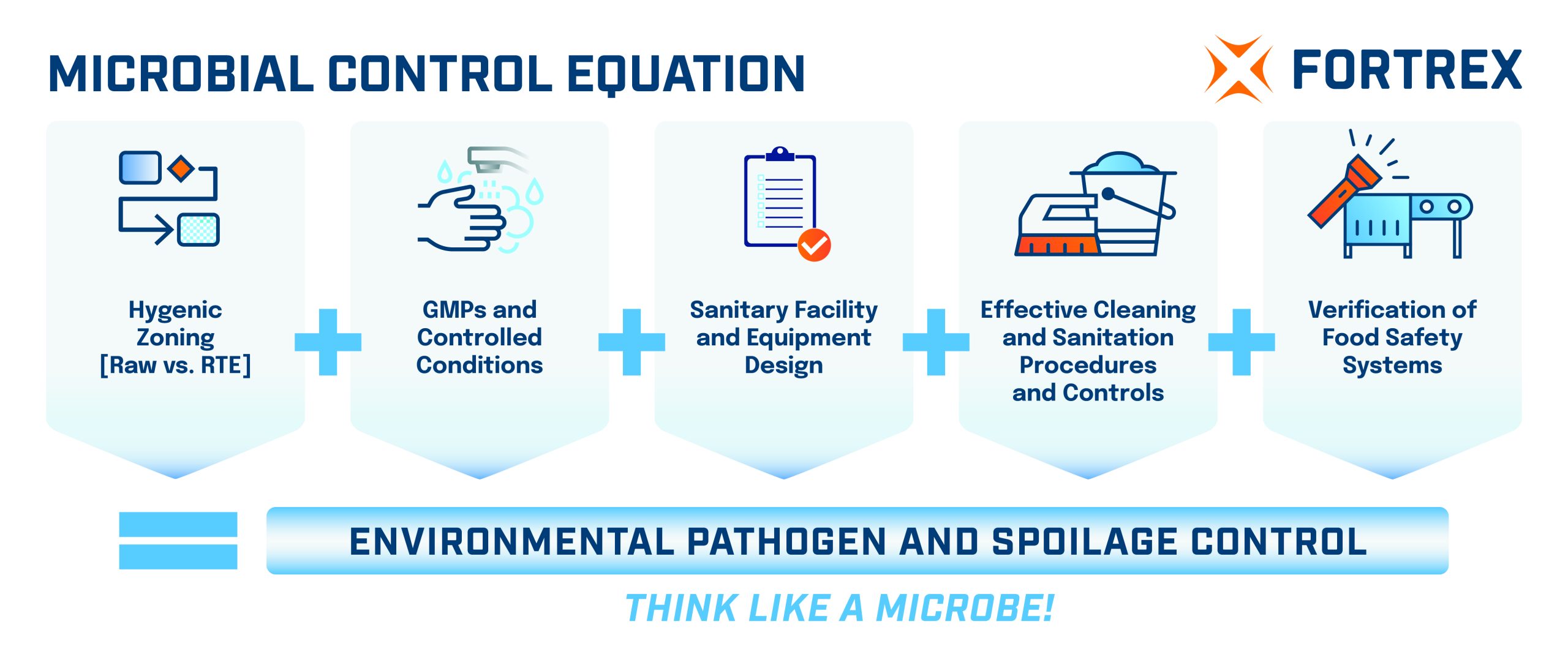
What better time to deep dive into the Microbial Control Equation (MCE) than in the thick of Listeria season and during National Food Safety Education month? The timing is perfect! The MCE outlines the components a food plant must have to control pathogens and spoilage organisms in the environment.
Hygienic zoning is the practice of keeping raw separate from ready-to-eat. It is far more likely to find microorganisms in raw areas, so it is paramount to manage the cross-contamination potential from these raw areas into RTE areas. Not only is hygienic zoning within the facility extremely important but also limiting ways microorganisms enter the facility in the first place. Examples of vectors microbes use to get into the facility include raw materials, employees, air, and water.
When a microbe enters the facility it is called a transient microorganism. Unfortunately it happens but fortunately food safety programs are designed to eliminate these microbes that make their way inside. However, if these microbes get inside and find a home within a biofilm or harborage area where it is challenging to remove them, they become resident microorganisms. Effective cleaning and sanitation procedures and controls, as part of the MCE, target both transient and resident microbes.
Biofilms within harborage areas are the perfect homes for microorganisms; there’s food, water, and protection from sanitation. Where we cannot access surfaces for sanitation, those areas must be part of our Master Sanitation Schedule (MSS), whether that is overheads or sandwich points on equipment. The more hygienically designed infrastructure and equipment is, the less we have to rely on MSS deep cleaning tasks. By designing the plant and equipment such that everything is cleanable and accessible to be cleaned, you limit dependence on periodic infrastructure and equipment cleaning and decrease the risk of microbial contamination from harborage areas.
The Microbial Control Equation is a great tool to use when trying to control pathogens or spoilage organisms. Think like a microbe. How can I get into the plant? Are there conditions allowing me to survive and thrive? Work through each food safety component to eliminate any gaps in microbial control. Successful food safety programs lead to microbial control, which leads to preventing foodborne illnesses.